Best Buick for Empty Nesters Downsizing From a Full-Size SUV
Moving out of a full-size SUV does not have to mean giving up the comfort, quiet ride, cargo flexibility, or upscale features you have grown accustomed to.
For shoppers searching for the Best Buick for Downsizing, Buick’s current crossover lineup offers several logical steps down from a large three-row SUV. The Encore GX is the most compact choice, the Envista emphasizes style and value, and the Envision provides a more substantial compact-SUV experience that may feel more familiar to longtime full-size SUV owners.
The right answer depends less on finding the smallest Buick and more on choosing the amount of space, comfort, and equipment you actually use now.
Empty nesters often discover that much of a full-size SUV’s capability goes unused once daily family-hauling duties disappear. Three rows, a large cargo area, and substantial exterior dimensions can become more of an inconvenience than an advantage, particularly in parking garages, crowded shopping centers, and smaller home garages.
Buick’s smaller crossovers retain the elevated seating position many SUV owners prefer. That can make the transition easier than switching directly to a sedan, especially for drivers who appreciate easier entry and exit and a more commanding view of traffic.
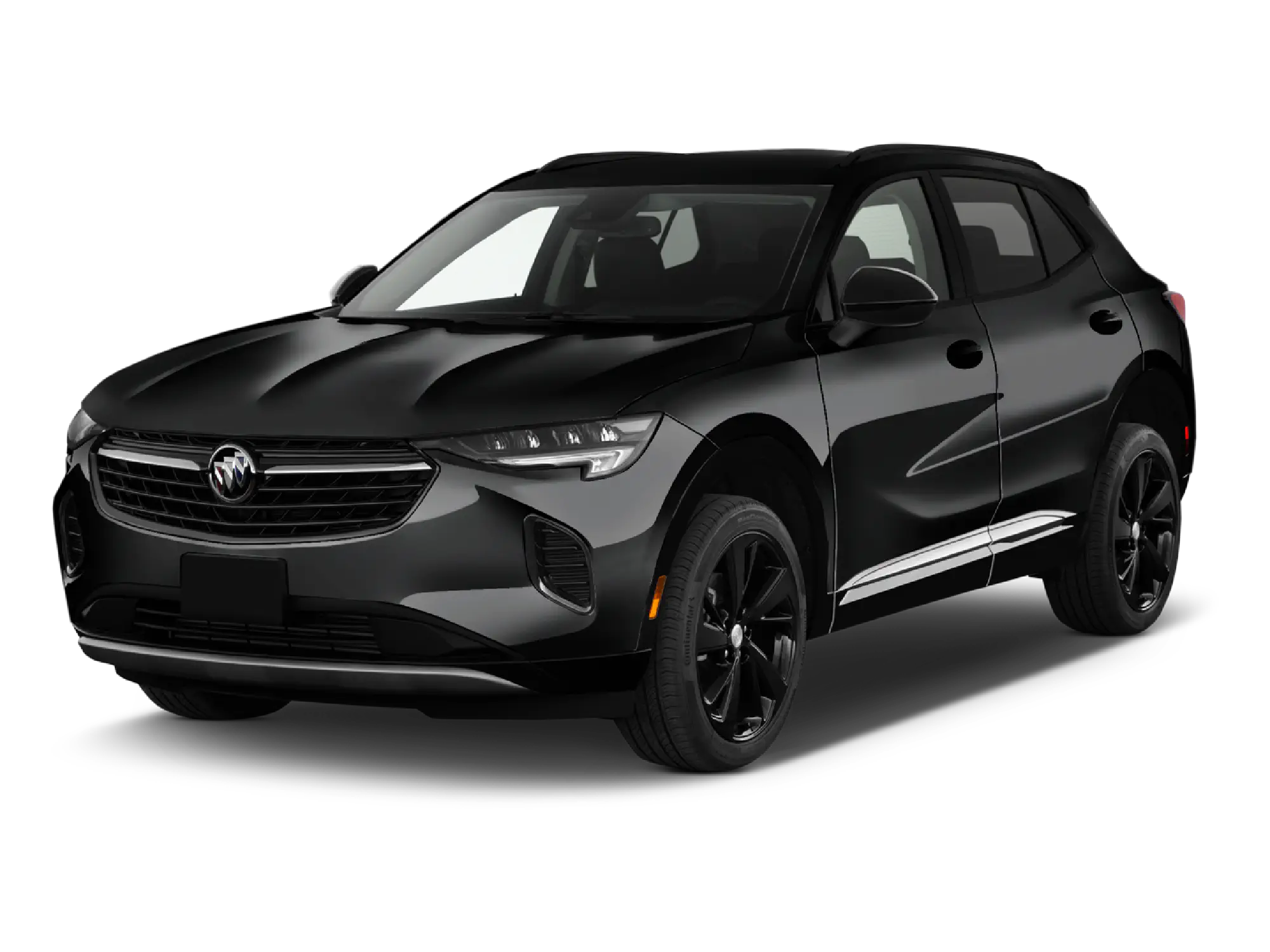
Among Buick’s smaller choices, the Envision is likely to feel most familiar to someone coming from a larger premium-oriented SUV. The Encore GX goes considerably smaller, while the Envista takes a lower, sleeker approach.
| Buick Model | General Size | Best Fit for Downsizers | Key Trade-Off |
|---|---|---|---|
| Encore GX | Subcompact SUV | Drivers prioritizing easy maneuverability | Less cabin and cargo room than larger SUVs |
| Envista | Subcompact crossover | Style and value-focused buyers | Lower, more coupe-like profile |
| Envision | Compact SUV | Buyers wanting a gentler transition from a full-size SUV | Larger footprint than Encore GX or Envista |
Current trims, specifications, and equipment can change by model year, so shoppers should verify the exact configuration before purchasing.
Downsizing is about more than exterior dimensions. A smaller vehicle changes virtually every part of day-to-day ownership, from parking and fuel consumption to cargo planning and passenger accommodations.
Drivers accustomed to a full-size SUV may immediately notice how much easier a compact crossover is to place within a parking space. Narrow streets, drive-through lanes, garages, and urban parking can become noticeably less stressful.
There are compromises. Carrying four adults plus luggage requires more planning, and bulky purchases that disappear into the back of a full-size SUV may require folding seats in a smaller Buick.
For many empty nesters, those limitations occur infrequently enough to be worthwhile. If most trips involve one or two occupants, hauling around unused third-row seating every day may no longer make sense.
The Best Buick for Downsizing is therefore the model that eliminates excess size without eliminating the features you regularly enjoy.
The Encore GX is worth considering when reducing vehicle size is the main objective. Its compact footprint suits drivers who want an SUV-like seating position without the bulk associated with traditional midsize and full-size utility vehicles.
The Envista approaches the same general market differently. Its design is lower and more streamlined, making it appealing to drivers who want crossover practicality but do not necessarily need the traditional shape of an SUV.
The Envision represents the middle ground for many former full-size SUV owners. It provides a more substantial cabin and road presence than Buick’s smallest crossovers while remaining considerably easier to manage than a large three-row utility vehicle.
That distinction matters. Moving directly from a large SUV to the smallest available crossover can initially feel restrictive, even when its specifications suggest sufficient space.
A test drive should include more than a quick trip around the dealership. Drivers should evaluate visibility, seat comfort, entry and exit, highway noise, cargo loading height, control placement, and how naturally the vehicle fits into a normal parking space.
Routine ownership expenses vary considerably according to model year, drivetrain, mileage, location, dealer labor rates, and the specific repair required. Downsizing does not automatically make every repair inexpensive, particularly because modern compact crossovers contain sophisticated electronics, turbocharged engines, driver-assistance technology, cameras, sensors, and infotainment systems.
Basic diagnostic work can commonly cost roughly $100 to $250 before repairs, although local rates vary. A battery replacement might cost a few hundred dollars, while more complicated electronic, air-conditioning, turbocharger, transmission, or driver-assistance repairs can potentially reach four figures.
| Service or Repair Category | Approximate Cost Range* |
|---|---|
| General diagnostic evaluation | $100 to $250 |
| Battery replacement | $200 to $450 |
| Brake service | $300 to $900+ |
| Infotainment/electrical diagnosis or repair | $150 to $1,500+ |
| Air-conditioning repair | $200 to $2,000+ |
| Major powertrain repair | $1,500 to several thousand dollars |
These figures are broad planning estimates, not quotes. Vehicle configuration, parts requirements, labor rates, taxes, diagnostic time, and the actual failure can substantially change the final bill.
Smaller exterior dimensions should not be confused with mechanical simplicity. A well-equipped compact Buick can still contain a significant amount of technology, which makes maintenance history and warranty status worth considering alongside purchase price.
Good maintenance starts with following the schedule specified for the exact Buick model, engine, and model year. Oil changes are especially important on turbocharged engines because clean oil plays an important role in lubrication and heat management.
Owners should also pay attention to battery condition. Modern vehicles depend heavily on stable electrical voltage, and a weakening battery can sometimes contribute to unusual electronic behavior before it fails completely.
Tires deserve equal attention. Correct pressure, regular rotations, proper alignment, and adequate tread depth affect braking, ride quality, fuel economy, and wet-weather performance.
Drivers who primarily make short trips may also benefit from periodically giving the vehicle a longer drive once it is fully warmed up. Most importantly, unusual noises, warning lights, shifting behavior, fluid leaks, or changes in engine performance should be investigated rather than ignored.
Keep maintenance and repair documentation as well. A complete service history can make diagnosing future issues easier and can be valuable when selling or trading the vehicle.
A Technical Service Bulletin, commonly called a TSB, is information issued by an automaker to help service technicians diagnose or repair a known vehicle condition. A TSB is not automatically the same thing as a safety recall, and its existence does not necessarily mean every vehicle of that model will experience the problem.
Before buying a specific used Buick, owners can search for manufacturer communications, recalls, and TSB-related information through the National Highway Traffic Safety Administration. Searching by the exact model year and vehicle is more useful than assuming an issue applies across an entire nameplate.
A pre-purchase inspection remains worthwhile even when online research reveals no major concerns. Vehicle condition and maintenance history can matter just as much as general model reputation.
The biggest concern is choosing a vehicle based solely on size or price. A crossover can look perfect on paper and still prove frustrating if its seats, visibility, cargo opening, ride quality, or controls do not suit the owner.
Think about unusual trips as well as ordinary ones. If you regularly travel with another couple, carry golf clubs, transport pets, or take extended road trips, bring those requirements into the shopping process.
The Envision may provide the most natural transition for drivers who still value room and a substantial SUV feel. The Encore GX makes more sense when compact dimensions are a priority, while the Envista deserves consideration when styling and everyday practicality matter more than traditional SUV proportions.
There is no universal Best Buick for Downsizing because downsizing itself means something different for every household. The goal is to stop paying for and maneuvering space you rarely use without sacrificing the comfort and functionality you still value.
A smaller Buick may reduce some everyday ownership burdens, but long-term repair exposure remains part of owning any modern vehicle. Infotainment hardware, climate-control components, cameras, sensors, turbocharged powertrains, and other systems can become expensive once applicable original warranty coverage ends.
Before purchasing additional protection, compare the contract’s covered components, exclusions, deductible, term, mileage limits, cancellation provisions, transfer rules, and repair procedures. Coverage varies, so the contract itself should always determine what is and is not covered.
For drivers planning to keep their downsized Buick for several years, Granger Warranty provides extended vehicle protection options with upfront online pricing. Owners can review available coverage while deciding whether predictable protection makes sense for their expected ownership period.
The Envision is a strong model to investigate when you want to reduce exterior size without immediately moving into Buick’s smallest crossover class. Drivers who prioritize maximum maneuverability should also compare the Encore GX, while the Envista offers a more style-oriented alternative.
It can feel substantially smaller, particularly in cargo capacity and rear-seat space. For households that now travel primarily with one or two people, that smaller footprint may be exactly the benefit they are seeking.
Its compact-SUV dimensions make the Envision worth considering for empty nesters who want easier maneuverability while retaining a conventional SUV format. Seat comfort, visibility, cargo requirements, and preferred features should be evaluated during an extended test drive.
Either can work. A new vehicle provides the latest equipment and applicable new-vehicle warranty coverage, while a used Buick may lower the purchase price. Used shoppers should pay particular attention to maintenance records, accident history, remaining warranty coverage, recalls, and a professional pre-purchase inspection.
It depends on how long you expect to own the vehicle, its existing coverage, your tolerance for unexpected repair bills, and the terms and price of the protection plan. Compare coverage details and exclusions rather than evaluating a plan solely by its monthly or upfront cost.
Downsizing should make ownership simpler, not make the vehicle feel compromised. Compare the Encore GX, Envista, and Envision based on the trips you actually take, the passengers and cargo you actually carry, and the features you would miss from your current full-size SUV.
Once you have chosen your next Buick, consider how long you plan to keep it and what repair expenses you would prefer to handle yourself. Visit Granger Warranty to review available extended coverage options and upfront pricing for eligible vehicles.
Stay up to date with the latest news from Granger Warranty