Best Cadillac for a Weekend Road Trip: CT5 vs CT4
Weekend road trips put a different set of demands on a luxury sedan than the average commute.
A car that feels quick and comfortable during a 20-minute drive may feel considerably different after four hours of interstate travel with passengers, luggage, and another few hundred miles still ahead.
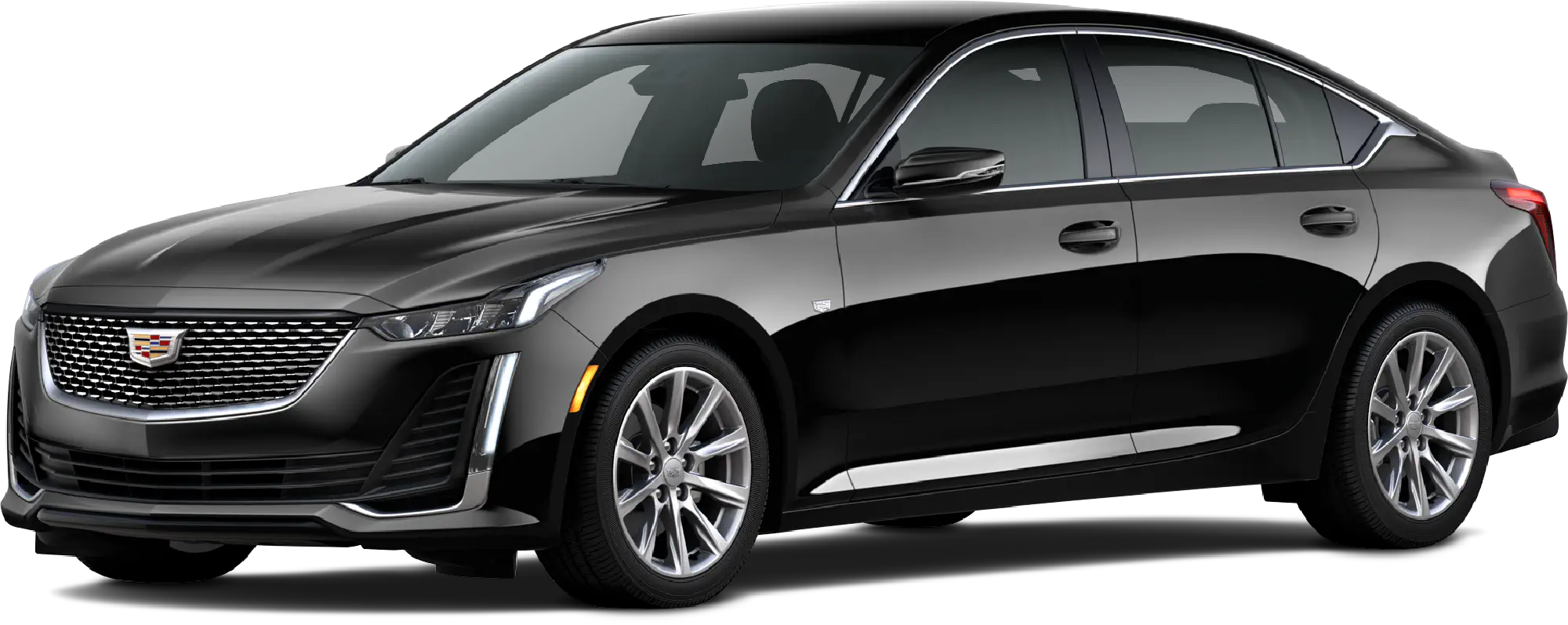
For shoppers considering a Cadillac CT5 vs CT4 road trip, both sedans offer turbocharged performance, available all-wheel drive, and Cadillac comfort. Yet their different sizes, prices, rear-seat dimensions, and cargo capacities make them better suited to different types of travelers.
For most couples and solo travelers, the CT4 offers a compelling combination of manageable size and lower purchase price. For families, four-adult trips, or anyone who regularly packs heavily, the larger CT5 has several advantages that become more noticeable as the miles accumulate.
Size is one of the most important differences between these two sedans. The 2026 Cadillac CT4 measures 187.2 inches long on a 109-inch wheelbase, while the CT5 stretches 193.8 inches with a 116-inch wheelbase.
Both models seat up to five people and provide 42.4 inches of front legroom. Rear-seat passengers get 33.4 inches of legroom in the CT4 compared with 37.9 inches in the CT5, making the CT5 substantially more accommodating when adults will spend several hours in the second row.
Cargo capacity follows the same pattern. Cadillac lists 10.7 cubic feet of cargo volume for the CT4 and 11.9 cubic feet for the CT5.
| Road Trip Consideration | Cadillac CT4 | Cadillac CT5 |
|---|---|---|
| Vehicle Length | 187.2 inches | 193.8 inches |
| Wheelbase | 109 inches | 116 inches |
| Front Legroom | 42.4 inches | 42.4 inches |
| Rear Legroom | 33.4 inches | 37.9 inches |
| Cargo Volume | 10.7 cu. ft. | 11.9 cu. ft. |
| Seating Capacity | Up to 5 | Up to 5 |
| 2026 Starting Price | $36,000 | $49,200 |
Pricing shown reflects Cadillac’s published starting prices for the 2026 models and can change with trims, options, destination charges, and incentives.
Those numbers help define each sedan’s personality. A couple taking a two-night trip may have little trouble fitting everything into the CT4. Add two adults in the back, and several full-size suitcases, and the CT5 becomes the easier car to live with.
Power does not necessarily separate the standard versions as much as shoppers might expect. Both models offer a 2.0-liter turbocharged engine rated at 237 horsepower and 258 lb-ft of torque with premium gasoline.
The CT4 also offers a 2.7-liter turbocharged engine on Premium Luxury models, producing 310 horsepower and 350 lb-ft of torque with premium fuel. Buyers interested in stronger acceleration without moving to a V-Series model may find that option appealing.
Road-trip priorities are rarely about acceleration alone. Cabin space, seat comfort, driver-assistance technology, luggage capacity, ride quality, and ease of maneuvering at the destination can matter more.
The CT4’s smaller dimensions can be useful once the highway portion ends. It is easier to place in tight parking areas and is better suited to urban destinations where garages and street parking can be cramped.
The CT5 makes its strongest argument on the open road. Its extra wheelbase and much greater rear legroom make it the more natural choice for longer journeys with multiple passengers.
Neither sedan should be judged solely by the possibility of a future repair, but luxury-car buyers should budget for maintenance and unexpected mechanical or electronic problems after warranty coverage expires. Modern Cadillacs combine turbocharged engines, sophisticated electronics, infotainment hardware, driver-assistance systems, and numerous sensors.
A straightforward diagnostic appointment may cost roughly $100 to $250 depending on the shop, location, and complexity of the problem. More involved repairs can quickly reach four figures if they require major electronic modules, turbocharger-related components, air-conditioning hardware, drivetrain parts, or extensive labor.
Approximate repair ranges are useful for budgeting, but they should not be interpreted as guaranteed Cadillac repair prices.
| Repair or Service Category | Approximate Cost Range |
|---|---|
| General Diagnostic Work | $100 to $250+ |
| Battery Replacement | $200 to $500+ |
| Brake Service | $400 to $1,200+ |
| Sensor or Electronic Repair | $250 to $1,500+ |
| Infotainment or Module Repair | $500 to $2,000+ |
| Major Turbo or Drivetrain Repair | $1,500 to $5,000+ |
Actual costs vary substantially by model year, drivetrain, labor rate, parts required, diagnosis, and whether additional damage is present. Owners should obtain a vehicle-specific diagnosis and written estimate before authorizing repairs.
This matters for road-trip buyers because mileage can accumulate quickly. A vehicle driven 12,000 miles annually under normal use might accumulate significantly more when weekends regularly include 500-mile trips.
Preventive maintenance is more valuable than any roadside repair strategy. Before a long drive, check the engine oil level, coolant condition, tires, brakes, battery, exterior lighting, and windshield washer system.
Tire pressure deserves particular attention. Pressure that is significantly above or below the manufacturer’s recommendation can affect handling, tire wear, fuel consumption, and heat buildup during sustained highway driving.
Owners should also follow the maintenance schedule for their specific model year rather than relying on generic intervals. Service requirements can differ by engine, drivetrain, mileage, operating conditions, and model year.
Before buying a used CT4 or CT5, review its service history and arrange a pre-purchase inspection. Evidence of consistent maintenance can be more meaningful than a low odometer reading accompanied by incomplete records.
It is also worth checking recalls and Technical Service Bulletins, commonly called TSBs. A TSB is information a manufacturer provides to technicians about known symptoms, diagnostic procedures, service updates, or repair methods. A TSB is not automatically the same thing as a recall, and its existence does not necessarily mean every vehicle will experience the described condition.
Owners and shoppers can research vehicle information through the NHTSA and use the agency’s vehicle and manufacturer resources to investigate recalls and manufacturer communications rather than relying on isolated online reports.
Concern should be proportional to how long you intend to own the vehicle. Someone leasing a new Cadillac for a few years faces a very different financial equation than someone purchasing a CT5 and planning to keep it well past 100,000 miles.
Luxury vehicles can become more expensive to repair as they age because even relatively ordinary systems may involve additional sensors, modules, cameras, specialized components, or labor. That does not make the CT4 or CT5 poor road-trip choices. It simply means long-term ownership deserves more planning than fuel and oil changes alone.
Mileage is especially important for frequent travelers. Drivers who add 15,000 to 20,000 miles per year may reach major maintenance milestones and the end of original warranty periods sooner than low-mileage owners.
Keeping an emergency repair fund is one approach. Extended vehicle coverage is another option for owners who prefer to exchange some unpredictable repair exposure for a more structured ownership expense.
For pure road-trip duty, the CT5 is the stronger overall choice. Its advantage is not dramatically greater engine output in standard form, but the extra room available to passengers and luggage.
Four adults will appreciate the CT5’s additional 4.5 inches of published rear legroom. Travelers carrying luggage for several people will also benefit from its larger trunk.
The CT4 still has an important advantage: value. Cadillac lists the 2026 CT4 from $36,000 compared with $49,200 for the CT5, creating a substantial starting-price difference.
That makes the CT4 attractive for couples, solo travelers, and buyers who want Cadillac features without paying for space they rarely use.
| Type of Traveler | Better Choice | Why |
|---|---|---|
| Solo Weekend Traveler | CT4 | Lower starting price and compact dimensions |
| Couple With Light Luggage | CT4 | Plenty of front-seat room without paying for extra rear space |
| Four Adults | CT5 | Significantly more rear legroom |
| Longer Multi-Day Trips | CT5 | More passenger and cargo room |
| City and Highway Combination | CT4 | Easier to maneuver in tighter spaces |
| Frequent Highway Traveler | CT5 | Larger cabin is better suited to extended trips |
| Budget-Focused Luxury Buyer | CT4 | Lower entry price |
Neither answer is universal. Buyers should sit in both cars, load the trunk if possible, and consider who will actually occupy the rear seats rather than selecting based solely on exterior styling.
Frequent road trips accelerate mileage, and mileage eventually moves any vehicle beyond its original coverage period. Drivers planning to keep a CT4 or CT5 for many years may want to investigate extended protection before repair risk becomes a larger part of the ownership equation.
Granger Warranty provides extended vehicle coverage options with transparent pricing and an online purchasing process. Coverage details, exclusions, eligibility, deductibles, and terms vary, so owners should review the applicable plan carefully before purchasing.
For a road-trip vehicle, nationwide acceptance can be particularly valuable because a mechanical problem may occur hundreds of miles from home. Granger Warranty coverage is designed with nationwide use in mind, helping eligible owners avoid being tied to an unfamiliar restricted repair network.
Extended coverage is not a substitute for maintenance. Oil changes, tires, brakes, fluids, inspections, and other maintenance items remain part of responsible ownership regardless of protection plan.
For most travelers carrying passengers, the CT5 is the better long-distance choice because it provides more rear legroom and cargo capacity. The CT4 makes more sense for solo drivers and couples who prioritize a lower purchase price and smaller exterior dimensions.
Yes. Cadillac lists 37.9 inches of rear legroom for the 2026 CT5 compared with 33.4 inches for the CT4. That difference can become meaningful when adults spend several hours in the rear seat.
Cadillac lists the CT5 at 11.9 cubic feet of cargo volume and the CT4 at 10.7 cubic feet. Neither is an SUV-sized cargo hauler, so travelers with several large suitcases should inspect the trunk before buying.
Yes. Two travelers can take advantage of the CT4’s generous front legroom while using the rear seats for additional bags when necessary. Its lower starting price also leaves more room in the budget for fuel, hotels, maintenance, or optional equipment.
It can be worth considering when the vehicle will accumulate substantial mileage or remain in the household beyond its original warranty period. Compare the cost and terms of coverage with your tolerance for potentially paying major repair bills out of pocket, and review options through Granger Warranty before deciding.
CT4 shoppers get an appealing compact luxury sedan with strong front-seat space, available all-wheel drive, and a considerably lower starting price. CT5 buyers spend more but gain the rear-seat room and additional cargo capacity that make longer journeys with passengers easier.
For frequent weekend travelers, the CT5 is our overall road-trip pick, while the CT4 is the better value for couples and solo drivers.
Whichever Cadillac fits your travel plans, think beyond the first weekend away. Routine maintenance, mileage accumulation, and potential post-warranty repairs all influence the real cost of ownership.
Visit Granger Warranty to explore available extended coverage options and compare protection before your Cadillac starts accumulating serious road-trip mileage.
Stay up to date with the latest news from Granger Warranty