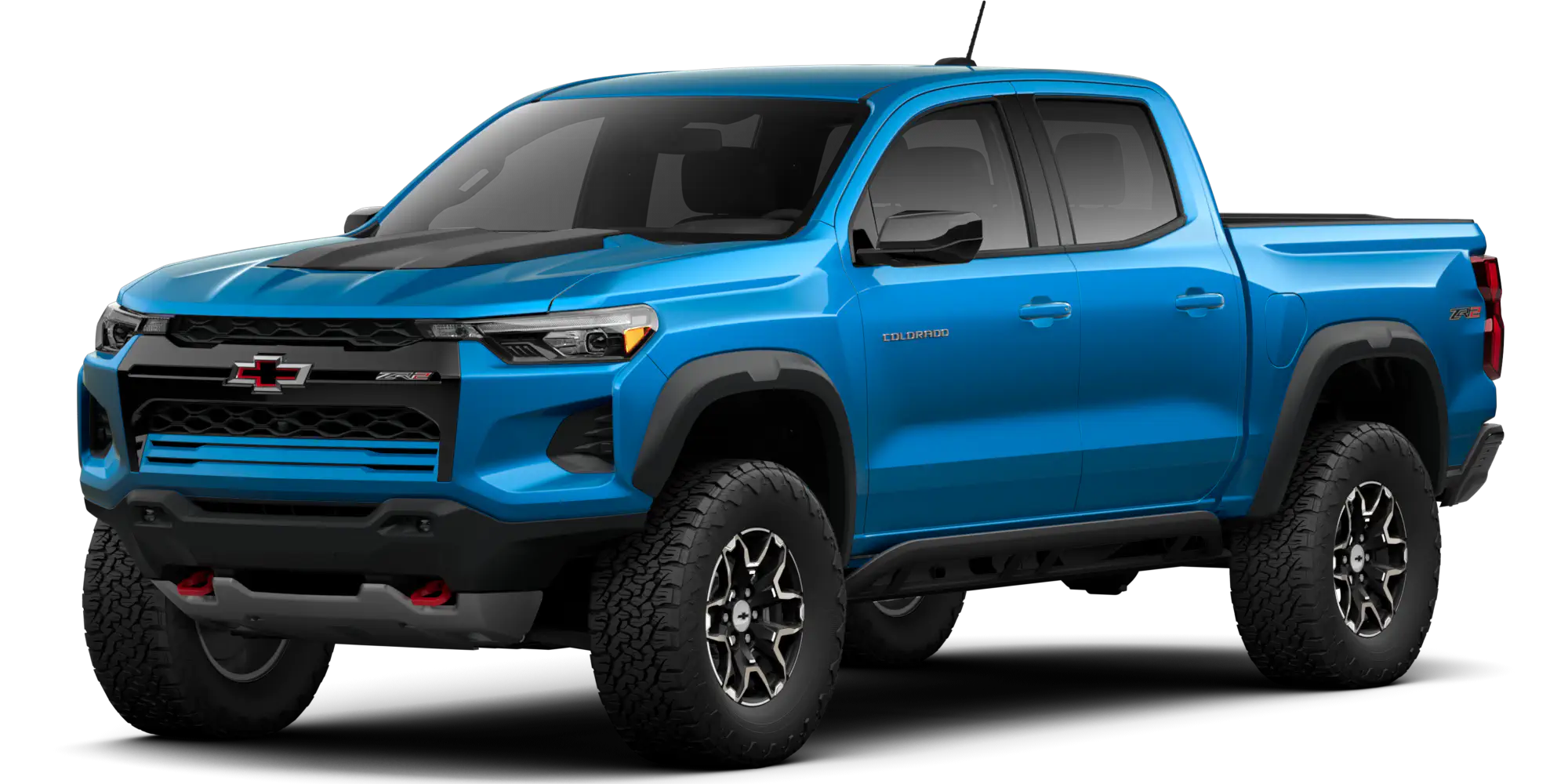
Best Chevrolet Colorado Trim for Off-Road: Trail Boss vs ZR2
Choosing an off-road midsize pickup often comes down to how far off pavement you actually plan to travel.
For Chevrolet buyers, the Chevy Colorado Trail Boss vs ZR2 comparison is especially interesting because both trucks start with genuine off-road hardware, yet they target noticeably different drivers.
Trail Boss is the practical choice for owners who want additional ground clearance, four-wheel drive, all-terrain capability, and a rugged stance without paying for specialized hardware they may rarely use. ZR2 moves considerably further toward technical trail driving with Multimatic DSSV dampers, larger tires, additional ground clearance, front and rear locking differentials, and more aggressive off-road geometry.
For many buyers, Trail Boss provides the better value. For drivers who regularly encounter rocks, deep ruts, steep climbs, loose terrain, or higher-speed desert trails, the ZR2’s additional capability can justify its higher purchase price and potentially higher long-term maintenance costs.
Chevrolet engineered the current Colorado lineup with distinct chassis configurations rather than simply adding appearance packages. Trail Boss receives a 2-inch factory lift and wider stance, while the ZR2 uses a 3-inch factory-installed lift paired with a high-performance suspension. Chevrolet lists the 2026 ZR2 with 33-inch tires and Multimatic DSSV dampers.
Both trims use Chevrolet’s 2.7-liter TurboMax four-cylinder, currently rated at 310 horsepower and 430 lb-ft of torque. That means buyers are not paying for significantly different engine performance when stepping into the ZR2. They are primarily paying for suspension, traction, protection, tires, geometry, and specialized off-road equipment.
That distinction matters because it makes the Trail Boss surprisingly capable for its price. Drivers who mainly encounter forest roads, hunting trails, snow, muddy access roads, campsites, and moderate Colorado trails may never reach the point where the ZR2’s more sophisticated hardware becomes necessary.
Exact specifications can vary slightly by model year and configuration, but the fundamental differences between these two trucks are substantial.
| Feature | Colorado Trail Boss | Colorado ZR2 |
|---|---|---|
| Engine | 2.7L TurboMax | 2.7L TurboMax |
| Output | 310 hp / 430 lb-ft | 310 hp / 430 lb-ft |
| Factory Lift | 2 inches | 3 inches |
| Ground Clearance | Approx. 9.5 inches | Approx. 10.7 inches |
| Standard Tire Size | Approx. 32-inch all-terrain | 33-inch off-road tires |
| Rear Locker | Automatic locking rear differential | Electronic locking rear differential |
| Front Locker | No | Yes |
| Dampers | Conventional off-road suspension | Multimatic DSSV |
| Baja Mode | No | Yes |
| Maximum Towing When Properly Equipped | Up to 7,700 lbs | Up to 6,000 lbs |
| Best Use | Daily driving and moderate trails | Technical and aggressive off-roading |
Chevrolet’s original specifications for the current-generation trucks listed approximately 9.5 inches of ground clearance for Trail Boss and 10.7 inches for ZR2. Chevrolet also gave the ZR2 considerably more aggressive approach, breakover, and departure angles.
Those numbers become meaningful on uneven terrain. An extra inch of clearance may not sound dramatic in a dealership parking lot, but it can determine whether a rock passes beneath the truck or contacts an underbody component.
ZR2 earns its price premium when terrain becomes genuinely difficult.
Its Multimatic DSSV dampers are one of its biggest advantages. Rather than being designed simply to provide additional ride height, the DSSV system is engineered to manage suspension movement across different driving conditions, giving the ZR2 impressive control both on pavement and over rough terrain.
Chevrolet also equips the current ZR2 with front and rear electronic locking differentials. That feature can make an enormous difference when one or more wheels lose traction on rocks, deep ruts, steep inclines, or uneven surfaces.
The ZR2’s 33-inch tires provide additional sidewall and ground clearance, while its more aggressive approach and departure geometry reduces the likelihood of bumper contact.
Drivers interested in serious rock crawling or demanding trails should therefore lean toward the ZR2.
Capability does not automatically make ZR2 the best Colorado for every owner.
Trail Boss gives buyers much of the visual presence and useful ground clearance of the ZR2 while retaining a simpler suspension system and stronger towing capability. For someone commuting during the week and exploring forest roads or moderate trails on weekends, that balance can be more useful than maximum articulation or locking differentials.
Price is another important factor.
For the 2025 model year, Edmunds listed the Trail Boss at a $41,395 starting MSRP compared with $51,195 for the ZR2, a difference of roughly $9,800 before options. Current pricing changes by model year and equipment, but the gap illustrates how much buyers can save by realistically evaluating the trails they intend to drive.
Saving thousands upfront also leaves room for useful equipment such as recovery gear, quality tires, bed storage, rock protection, camping equipment, or simply fuel for more trips.
Off-road trucks generally expose suspension, steering, tires, wheels, skid plates, and driveline components to more punishment than street-driven pickups. Consequently, ownership costs depend as much on how the vehicle is used as which badge is attached to the bedside.
Typical independent-shop costs can vary substantially by location, but owners should budget roughly:
| Service Or Repair | Approximate Cost Range |
|---|---|
| Four-Wheel Alignment | $120-$250 |
| Wheel/Tire Balance | $80-$200 |
| Off-Road Tire Replacement, Set Of Four | $900-$1,800+ |
| Suspension/Steering Diagnosis | $120-$250 |
| Tie Rod Or Steering Component Repair | $250-$900+ |
| Wheel Bearing/Hub Repair | $400-$800 Per Corner |
| Conventional Shock Replacement | $500-$1,500+ |
| Specialized ZR2 Suspension Repair | Potentially $1,500-$4,000+ |
These figures should be treated as general budgeting ranges rather than quotes. Labor rates, parts selection, vehicle condition, and the extent of trail damage can move the final invoice significantly.
ZR2 deserves particular attention because its Multimatic suspension is considerably more specialized than the Trail Boss setup. Owner reports from earlier-generation ZR2 trucks illustrate how expensive DSSV-related replacement work can potentially become after the vehicle ages, although those anecdotes should not be treated as evidence that every ZR2 will experience shock failure.
Off-road maintenance should begin before something actually breaks.
Inspect the tires after difficult trail runs for cuts, punctures, sidewall damage, missing tread blocks, and abnormal wear. Reduced tire pressure used on trails should also be returned to an appropriate road pressure before sustained highway driving.
Look underneath the truck for fresh scrapes, bent protection plates, leaks, damaged wiring, or packed mud. Mud collecting around suspension and driveline components can conceal damage and hold moisture against metal surfaces.
Alignment deserves special attention. Hard impacts against rocks, potholes, and washouts can alter alignment even when nothing looks visibly bent.
ZR2 owners should periodically inspect the DSSV dampers for signs of leakage or physical damage. Trail Boss owners should perform similar inspections of their conventional suspension components, particularly after aggressive off-road trips.
Follow Chevrolet’s recommended maintenance schedule for engine oil, filters, brakes, fluids, and other routine services. Vehicles frequently subjected to dust, towing, mud, or severe off-road operation may require closer inspection than trucks spending most of their lives commuting.
A Technical Service Bulletin, or TSB, is information issued by an automaker to help dealership technicians diagnose or repair a known vehicle condition. A TSB is not automatically the same thing as a recall, and the existence of a bulletin does not necessarily mean every vehicle covered by the bulletin will experience that problem.
Colorado owners can search for manufacturer communications and related vehicle information through the National Highway Traffic Safety Administration’s vehicle database. Model-year-specific bulletin databases are also available online, and Chevrolet dealers can check applicable GM service information using the vehicle’s VIN. Current Colorado listings demonstrate that service bulletins can address subjects ranging from software and powertrain operation to HVAC concerns.
Checking applicable TSBs can be particularly useful before paying for a difficult diagnosis. A dealership technician may already have an established diagnostic procedure for the exact symptom an owner is experiencing.
Neither truck should automatically be considered expensive to own simply because it is designed for off-road use. Driving conditions and modifications are major variables.
Trail Boss has an inherent advantage from a cost-control perspective because its off-road package is less mechanically specialized. Its conventional suspension may be simpler and potentially less expensive to service once the truck accumulates significant mileage.
ZR2 adds components that can cost more when replacement eventually becomes necessary. DSSV dampers, larger off-road tires, locking differential hardware, underbody protection, and additional trail equipment all add capability, but more specialized hardware can mean higher repair exposure.
Modification choices matter as well. Oversized tires, aggressive lifts, altered suspension geometry, and hard trail use can accelerate wear on wheel bearings, steering components, CV joints, suspension components, and tires.
For owners planning to keep either Colorado well beyond its original warranty period, potential repair costs should be considered alongside the initial purchase price.
Think about where the truck will actually spend its time.
Choose the Trail Boss if your driving consists primarily of pavement mixed with gravel roads, snow, camping routes, moderate trails, hunting access roads, and occasional off-road adventures. It provides meaningful clearance and traction without requiring the investment associated with the ZR2.
Choose the ZR2 if technical trails are an important part of your ownership plans. Drivers encountering rocks, ledges, deep ruts, steep terrain, desert running, and situations requiring maximum traction can make legitimate use of its front and rear lockers, DSSV dampers, 33-inch tires, and improved geometry.
Towing can also influence the decision. The Trail Boss can be configured for up to 7,700 pounds of towing capacity, while the trail-focused ZR2 is rated lower at up to 6,000 pounds when properly equipped.
For someone pulling a camper one weekend and exploring moderate trails the next, Trail Boss may actually be the more versatile Colorado.
Off-road capability does not eliminate the financial realities of owning a modern pickup. Turbocharged engines, electronic modules, infotainment hardware, four-wheel-drive components, sensors, cameras, and other systems can produce substantial repair bills as mileage increases.
Drivers planning to keep a Colorado for many years may want to compare extended coverage before the original vehicle warranty expires. Coverage terms, exclusions, deductibles, eligibility requirements, and modification rules should always be reviewed carefully, particularly when a vehicle is used off-road.
Granger Warranty provides extended vehicle protection options with straightforward online pricing. Colorado owners can review available plans at Granger Warranty and compare the cost of coverage against the repair exposure they are comfortable carrying themselves.
ZR2 can be worth the additional cost for drivers who regularly use difficult trails. Its DSSV dampers, front and rear electronic lockers, 33-inch tires, greater clearance, and improved off-road geometry provide capabilities that would be difficult to replicate properly with simple Trail Boss modifications.
For occasional off-road use, Trail Boss generally offers better value.
Trail Boss is arguably the more rational daily-driver choice because it combines legitimate trail capability with a lower purchase price and less specialized suspension hardware.
ZR2 remains surprisingly road-friendly, but buyers are paying for equipment primarily intended to improve performance when pavement ends.
Trail Boss uses an automatic-locking rear differential. ZR2 goes further with driver-selectable electronic locking differentials at both the front and rear, giving it a major advantage when negotiating highly uneven or low-traction terrain.
A Trail Boss can be upgraded with larger tires, suspension components, armor, and other equipment, but reproducing the complete ZR2 package is more complicated than installing a lift.
ZR2’s DSSV dampers, electronic lockers, drive modes, geometry, protection, and factory-integrated electronics make it difficult to duplicate economically. Buyers who already know they want serious technical-trail capability may save time and money by purchasing the ZR2 from the start.
Trail Boss may have the edge for owners focused on minimizing long-term costs because it delivers substantial capability with fewer specialized components.
ZR2 makes more sense when its extra equipment will actually be used. Paying more to maintain specialized off-road hardware is easier to justify when that hardware regularly gets the truck through terrain a Trail Boss would struggle to navigate.
Picking between Trail Boss and ZR2 ultimately comes down to matching capability with actual use. Trail Boss is the value-oriented all-rounder, while ZR2 is Chevrolet’s answer for drivers who genuinely intend to push their midsize truck deeper into difficult terrain.
Whichever trim fits your plans, consider what ownership may look like after the original warranty ends. Visit Granger Warranty to explore extended coverage options, review available pricing, and decide whether protecting your Colorado against eligible future repair costs fits your long-term ownership strategy.
Stay up to date with the latest news from Granger Warranty