Best Chevy Silverado for Overlanding and Off-Grid Trips
Building a Chevrolet Silverado for days away from pavement requires a different set of priorities than building a truck for towing, commuting, or weekend trail riding.
Range, payload, tire durability, suspension capability, recovery equipment, and mechanical simplicity can matter more than horsepower once the nearest paved road is 50 miles behind you.
A well-planned Silverado Overlanding Build starts with choosing the right truck before adding rooftop tents, refrigerators, auxiliary batteries, recovery boards, or bumpers. For most owners, the Silverado 1500 LT Trail Boss and ZR2 are the strongest starting points, while certain lower trims can make surprisingly capable budget builds.
Chevrolet’s current Silverado lineup offers four engine choices, including the TurboMax four-cylinder, 5.3-liter V8, 6.2-liter V8, and 3.0-liter Duramax diesel. The available Duramax produces 495 lb-ft of torque, and Chevrolet lists up to 28 mpg highway in certain configurations, making it especially interesting for long-distance travel.
Overlanding is less about conquering the hardest obstacle possible and more about traveling self-sufficiently across long distances. That distinction makes vehicle selection important.
A dedicated rock crawler benefits from maximum articulation, aggressive tires, and extreme clearance. An overland Silverado needs those qualities in moderation while retaining highway comfort, cargo capacity, fuel range, reliability, and enough payload for several hundred pounds of equipment.
For most buyers, the LT Trail Boss is arguably the sweet spot. Chevrolet equips Silverado Trail Boss models with off-road hardware including a factory-installed 2-inch lift, off-road-oriented suspension, and a two-speed Autotrac transfer case.
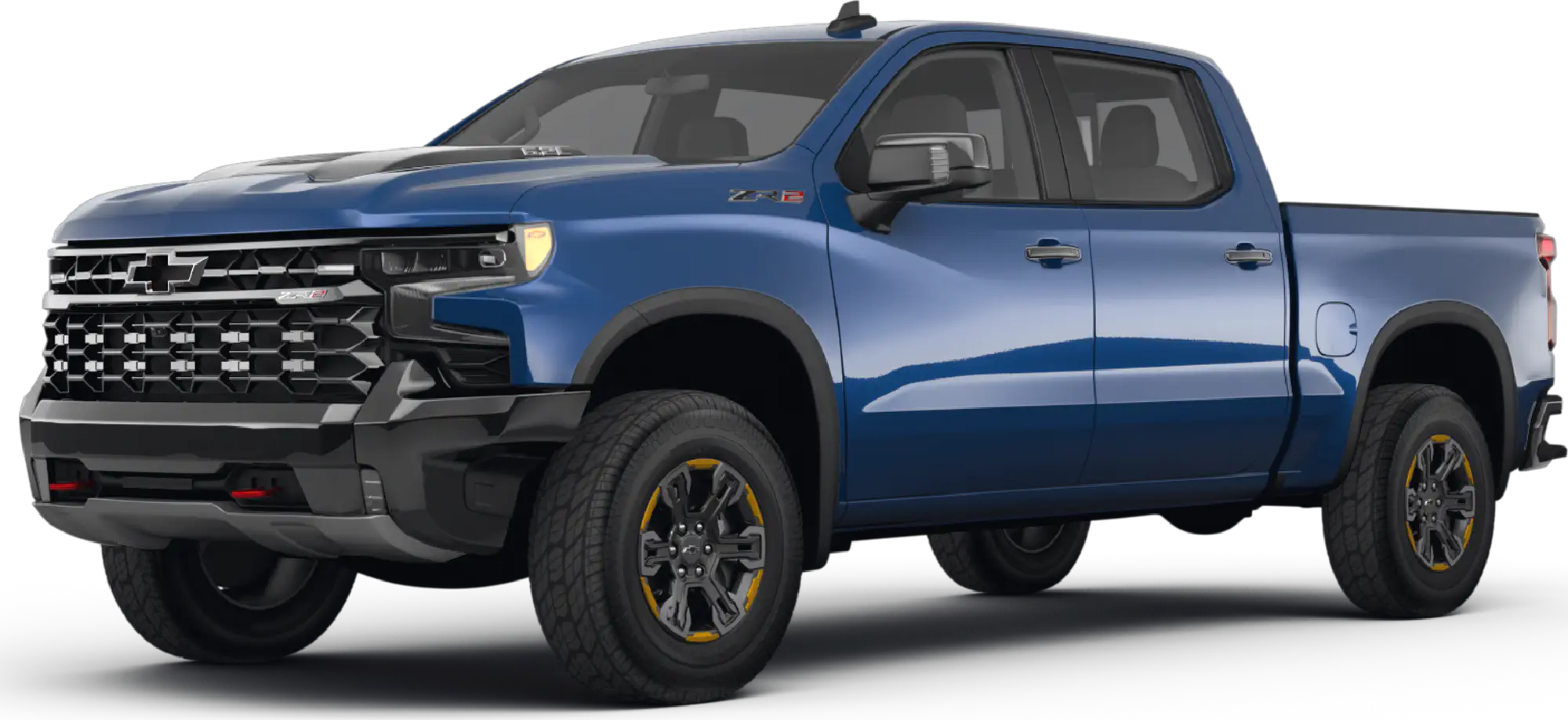
Drivers expecting considerably tougher terrain should look toward the Silverado ZR2. Chevrolet gives the ZR2 Multimatic DSSV dampers, front and rear electronic locking differentials, substantial aluminum skid plates, 33-inch Goodyear Wrangler Territory MT tires, and an off-road-cut front bumper providing a 33.5-degree approach angle.
Those features create an exceptionally capable factory foundation before the camping equipment even goes aboard.
| Silverado Trim | Overlanding Strength | Best Use | Key Consideration |
|---|---|---|---|
| WT 4x4 | Low purchase price and simple starting platform | DIY budget build | Requires more aftermarket upgrades |
| Custom Trail Boss | Factory lift and useful off-road equipment | Budget-conscious adventures | Fewer comfort features |
| LT Trail Boss | Excellent capability-to-comfort balance | Long-distance overlanding | Added equipment can quickly consume payload |
| ZR2 | Lockers, DSSV dampers, skid protection, aggressive tires | Technical and remote terrain | Higher purchase price |
| LTZ/High Country 4x4 | Excellent road-trip comfort | Light trails and camping | Less purpose-built for difficult trails |
The right answer therefore depends on your destination. Forest roads, desert tracks, and established dispersed camping routes rarely require a ZR2’s complete hardware package.
Rocky mountain trails, deep sand, washed-out roads, and more isolated terrain make the ZR2’s locking differentials and underbody protection substantially more valuable.
Weight is one of the biggest mistakes in pickup-based overlanding.
A camper shell, steel bumper, winch, rooftop tent, refrigerator, auxiliary battery, water, fuel, tools, recovery equipment, passengers, and camping supplies can add hundreds of pounds surprisingly quickly. Chevrolet lists a maximum available Silverado 1500 payload of 2,260 pounds, but that maximum does not apply to every configuration.
Your actual truck’s payload rating is the number that matters.
Check the certification and tire/loading labels on the vehicle rather than assuming a published maximum applies. Accessories installed on the truck, passengers, cargo, and trailer tongue weight can all reduce the remaining capacity.
For a practical build, prioritize equipment that solves real problems. Recovery points, appropriate all-terrain tires, underbody protection, a quality spare, basic tools, communications equipment, water storage, and reliable power are generally more valuable than accessories added primarily for appearance.
Engine choice becomes particularly interesting for travelers covering hundreds of miles between destinations.
The 3.0-liter Duramax is compelling because Chevrolet rates it at 305 horsepower and 495 lb-ft of torque. Chevrolet also advertises up to 28 mpg highway in qualifying Silverado configurations.
Diesel efficiency can translate into useful cruising range, although oversized tires, added weight, roof-mounted equipment, elevation, temperature, and trail conditions can substantially reduce real-world fuel economy.
The 5.3-liter V8 is another sensible choice. Its 355 horsepower and 383 lb-ft of torque provide plenty of performance for a moderately equipped overland truck while offering the familiar characteristics many Silverado buyers expect.
Chevrolet’s 6.2-liter V8 delivers 420 horsepower and 460 lb-ft of torque. It provides considerably more performance, but maximum horsepower is rarely the deciding factor when traveling slowly through remote terrain.
For range-oriented travel, the Duramax deserves serious consideration. For owners wanting a traditional gasoline V8, the 5.3-liter offers an attractive middle ground.
Turning a stock Silverado into a capable travel truck can range from a few thousand dollars to well into five figures.
| Upgrade | Approximate Budget Range |
|---|---|
| Quality all-terrain tires | $1,000-$1,800 |
| Skid plates/protection | $500-$2,000+ |
| Winch and recovery equipment | $800-$2,500+ |
| Bed rack or topper | $1,000-$4,000+ |
| Rooftop or bed-mounted tent | $1,000-$4,000+ |
| Auxiliary electrical system | $500-$3,000+ |
| Refrigerator/camping power | $500-$2,000+ |
| Suspension upgrades | $1,500-$5,000+ |
These are planning ranges rather than quotes. Labor, brands, fabrication requirements, and the starting configuration of the truck can change the total considerably.
Repair costs deserve equal attention. Remote travel puts extra strain on tires, wheel bearings, suspension components, steering components, cooling systems, driveline hardware, and underbody components.
Diagnosis can also become more expensive when intermittent noises, electronic warnings, four-wheel-drive problems, or suspension issues require significant technician time. Owners should budget for maintenance and repairs separately from accessory spending.
Spending $10,000 on camping equipment while postponing worn suspension components, aging tires, or fluid service is backwards. Mechanical condition should always come first.
Preventive maintenance becomes especially important when your travel plans involve areas without cell coverage or nearby repair facilities.
Start by following Chevrolet’s maintenance requirements for your specific model, engine, mileage, and operating conditions. Severe use involving dust, towing, extended idling, extreme temperatures, water crossings, and frequent low-speed trail driving may justify closer inspections.
Before longer trips, inspect tire condition and pressure, including the spare. Check engine oil, coolant, brake fluid, transmission and driveline components as applicable, suspension hardware, steering components, battery condition, belts, hoses, and visible underbody damage.
After difficult trails, inspect underneath the truck again. A skid plate can protect critical hardware without making the truck invincible.
Dust deserves attention as well. Extended driving on dusty roads can contaminate air filters faster than normal pavement use, so inspection intervals should reflect where the vehicle actually travels.
Avoid modifying the truck simply because an accessory is popular online. Every pound of equipment affects payload, while taller suspension and larger tires can alter handling, gearing, braking characteristics, fuel economy, and component loads.
A Technical Service Bulletin, or TSB, is a manufacturer communication that provides technicians with information about known symptoms, diagnostic procedures, updated parts, or recommended repair procedures. A TSB is not automatically the same thing as a recall, and its existence does not necessarily mean a repair will be performed free of charge.
Silverado owners can search manufacturer communications and TSB information through the National Highway Traffic Safety Administration’s vehicle lookup resources. NHTSA directs consumers to its recalls search, where manufacturer communications for specific vehicles can also be accessed.
Checking TSBs can be particularly useful before an extended trip if your Silverado has developed an unusual vibration, warning message, transmission behavior, suspension noise, electrical issue, or four-wheel-drive concern.
A properly maintained Silverado is a strong platform for long-distance adventure travel, but preparation matters more than the badge on the grille.
Going off grid introduces risks that normal commuting rarely exposes. A damaged tire five miles from town is inconvenient. The same failure 70 miles down an isolated trail can become a serious logistical problem.
Carry a properly inflated spare tire, tire repair equipment, an appropriate jack, basic tools, recovery equipment, first-aid supplies, water, navigation backups, and a way to communicate outside cellular networks when traveling in genuinely remote areas.
Fuel planning is equally important. Never assume the next small town will have an open station or the fuel grade your engine requires.
Mechanical modifications also deserve restraint. Extreme lifts, oversized tires, excessive weight, and heavily modified driveline components can create additional failure points.
A carefully equipped LT Trail Boss or ZR2 running sensible tire sizes may be a better expedition vehicle than a radically modified truck with impressive specifications but questionable durability.
Off-grid travel can accumulate mileage quickly. Owners may also keep their trucks longer because racks, electrical systems, storage solutions, tents, and other equipment are often designed around a particular vehicle.
That longer ownership timeline means expensive mechanical or electrical repairs can eventually become part of the equation.
Granger Warranty provides extended vehicle protection options for owners who want to reduce exposure to qualifying repair expenses as their vehicles age. Coverage details, eligibility, exclusions, deductibles, and terms vary, so owners should review the specific plan before purchasing.
This becomes especially relevant before the original warranty expires. Shopping while a truck is still relatively new can provide more options than waiting until it has accumulated substantial mileage.
You can explore current coverage information and available plans at Granger Warranty.
ZR2 is the better factory platform for difficult terrain because Chevrolet equips it with front and rear electronic locking differentials, Multimatic DSSV dampers, skid protection, 33-inch tires, and an off-road-specific front bumper.
LT Trail Boss may be the smarter all-around choice for owners spending more time on highways, forest roads, and moderate trails. It provides useful factory off-road equipment without requiring buyers to pay for every capability included with the ZR2.
Yes, particularly when driving range is important. Chevrolet rates the current 3.0-liter Duramax at 305 horsepower and 495 lb-ft of torque and advertises up to 28 mpg highway in qualifying configurations.
Actual overlanding fuel economy will generally be affected by larger tires, additional weight, aerodynamic accessories, elevation, and trail driving.
Use the payload information for your individual truck rather than Chevrolet’s maximum advertised Silverado payload. Chevrolet lists up to 2,260 pounds of maximum available payload for the 2026 Silverado 1500, but configuration has a major effect on the actual rating.
Passengers, water, camping equipment, bumpers, racks, auxiliary batteries, and trailer tongue weight all consume available payload.
Start with tires, recovery equipment, underbody protection where needed, and baseline mechanical maintenance. After that, build storage, sleeping, electrical, and communications systems around how you actually travel.
A stock truck with excellent tires and good recovery equipment can often travel farther reliably than an overloaded truck covered in unnecessary accessories.
Modifications can complicate warranty claims when an aftermarket component or alteration contributes to the failure being diagnosed. That does not mean installing one aftermarket accessory automatically eliminates every warranty protection on the vehicle.
Keep receipts and installation records, use reputable components, and understand both the vehicle manufacturer’s warranty terms and any extended coverage contract before making substantial suspension, drivetrain, engine, or electrical modifications.
Building an overland Silverado is ultimately about increasing where the truck can take you without sacrificing the dependability needed to get home.
For many travelers, an LT Trail Boss with the 3.0-liter Duramax offers an excellent combination of range, capability, comfort, and upgrade potential. Buyers regularly tackling more technical terrain should consider the ZR2 because much of the expensive off-road hardware is already installed and engineered as a complete package.
Whichever Silverado you choose, invest in maintenance before accessories, keep payload under control, and prepare the truck around realistic destinations rather than internet trends.
Owners planning to keep their Silverado beyond its original coverage period can also review extended protection options at Granger Warranty. Understanding potential repair exposure before factory coverage ends can make budgeting for years of road trips and off-grid adventures considerably easier.
Stay up to date with the latest news from Granger Warranty