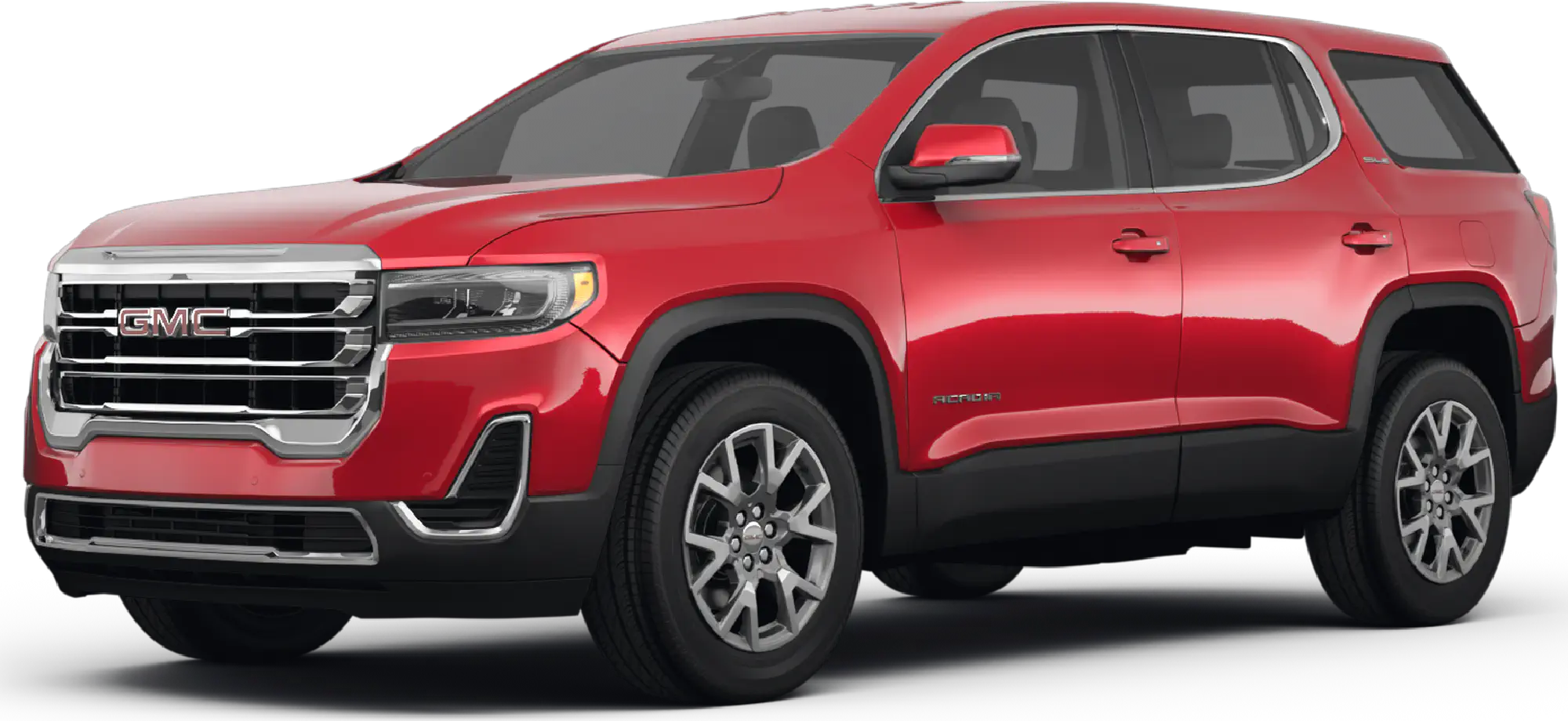
Best GMC SUV for Families: Acadia vs Yukon
Choosing between GMC’s two three-row SUVs comes down to how much space, towing capability, and everyday maneuverability your family actually needs.
In a GMC Acadia vs Yukon Family SUV comparison, both can carry up to eight passengers, but they approach family transportation from very different directions.
Acadia is a midsize SUV designed to balance passenger room, cargo flexibility, fuel costs, and daily drivability. Yukon is a full-size SUV that adds substantially more cargo capacity, stronger towing potential, and the road presence families may want for trailers, long-distance travel, or hauling a full cabin of passengers.
For many households, bigger is not automatically better. Understanding where each SUV excels can help you avoid paying for capability you rarely use or, on the other hand, buying too little vehicle for your family’s long-term needs.
Current Acadia models have grown considerably compared with earlier generations. GMC lists seating for up to eight passengers and as much as 97.5 cubic feet of cargo volume behind the first row, making the Acadia a legitimate three-row family vehicle rather than simply a compact alternative to the Yukon.
Yukon takes the same basic formula and scales it up. The standard-length Yukon offers seating for up to eight, while GMC lists 25.5 cubic feet of cargo volume behind the third row and 122.8 cubic feet behind the first row on certain configurations. Yukon XL stretches the formula even further, offering up to 41.5 cubic feet behind the third row and 144.5 cubic feet behind the first row.
For a family with two or three children that spends most of its time commuting, going to school, and running errands, the Acadia’s smaller footprint may actually be an advantage. Families regularly carrying several adults, bulky sports equipment, vacation luggage, or a trailer are more likely to appreciate the Yukon.
| Family-SUV Consideration | GMC Acadia | GMC Yukon |
|---|---|---|
| Vehicle Class | Midsize 3-row SUV | Full-size 3-row SUV |
| Maximum Seating | Up to 8 | Up to 8 |
| Max Cargo Behind Third Row | 23.0 cu. ft. | 25.5 cu. ft. |
| Max Cargo Behind First Row | 97.5 cu. ft. | 122.8 cu. ft. |
| Yukon XL Option | No | Yes, up to 144.5 cu. ft. behind first row |
| Maximum Acadia Trailering | Up to 5,000 lbs. when properly equipped | Greater capability depending on configuration |
| Best Fit | Daily family use and easier maneuverability | Large families, towing and heavy cargo |
Specifications vary by trim, drivetrain, equipment, and model year, so buyers should verify the exact vehicle before purchasing. GMC’s current model information is available through the GMC website.
Third-row seating can look impressive on a specification sheet but still become frustrating if children have trouble getting in or luggage consumes every inch behind the seats.
Acadia provides 23.0 cubic feet of maximum cargo volume behind its third row. Fold the third row and maximum cargo capacity behind the second row increases to 57.3 cubic feet. With both rear rows folded, maximum capacity reaches 97.5 cubic feet.
Standard Yukon provides slightly more room behind the third row at 25.5 cubic feet, but its biggest advantage becomes apparent when seats are folded. GMC lists up to 72.5 cubic feet behind the second row and 122.8 cubic feet behind the first row on Yukon AT4.
Yukon XL is the cargo champion. GMC lists 41.5 cubic feet behind the third row and 93.6 cubic feet behind the second row, making it particularly useful when every seat is occupied, and the family still needs room for luggage.
That difference matters on road trips. A family that routinely travels with strollers, hockey bags, camping equipment, coolers, or several large suitcases may find the Yukon, especially Yukon XL, considerably easier to live with.
Acadia’s current 2.5-liter turbocharged four-cylinder produces 328 horsepower and 326 lb-ft of torque, paired with an eight-speed automatic transmission. GMC rates properly equipped versions for up to 5,000 pounds of maximum trailering capacity.
That is enough capability for many small campers, utility trailers, boats, and recreational equipment, provided the specific trailer and vehicle configuration remain within all applicable weight ratings.
Yukon is the better choice when towing is a major part of family life. Its full-size platform and available powertrains are designed for considerably heavier-duty use than the Acadia, although maximum ratings depend on engine, drivetrain, axle ratio, equipment, passengers, and cargo.
Daily driving reverses some of that advantage. Acadia’s midsize dimensions generally make parking garages, school pickup lanes, grocery-store lots, and tight residential streets easier to manage.
Families should think about where the SUV will spend 90 percent of its time. Buying a Yukon for one camping trip each year may make less sense than buying an Acadia that better fits the daily commute, while frequent towing or fully loaded road trips can easily justify the Yukon’s extra size.
Purchase price is only the beginning of the financial comparison.
For 2026, GMC lists the Acadia with a starting MSRP of $43,800 before applicable destination charges, options, taxes, and fees. GMC lists the 2026 Yukon starting around $69,600, with Yukon XL priced higher.
The larger Yukon can also bring higher operating expenses. Larger tires, additional fluids, heavier-duty suspension and drivetrain components, and more complex available equipment can increase maintenance or repair costs as the vehicle ages.
Diagnosis costs for either SUV can range from roughly $100 to several hundred dollars depending on the shop, location, and complexity of the problem. A simple battery, sensor, or software-related issue is fundamentally different from diagnosing transmission, four-wheel-drive, suspension, climate-control, or advanced driver-assistance problems.
Major out-of-warranty repairs can reach thousands of dollars. That is why families planning to keep either SUV well beyond its original warranty period should consider total ownership costs rather than focusing exclusively on monthly payments.
Consistent maintenance matters more than choosing one GMC over the other if your goal is keeping the vehicle for 100,000 miles or longer.
Follow GMC’s maintenance schedule for oil and filter changes, tire rotations, brake inspections, fluid service, and other mileage-based items. Severe driving conditions, frequent towing, mountain driving, short trips, extreme temperatures, and heavy loads can justify more frequent inspections.
Pay particular attention to tires and brakes on a family SUV. Carrying passengers and cargo increases weight, and towing adds additional stress to braking, cooling, suspension, and drivetrain systems.
Software updates and warning lights also deserve attention. Modern Acadia and Yukon models use interconnected electronic modules for infotainment, safety systems, cameras, powertrain controls, and convenience features. Delaying diagnosis because a warning appears intermittently can make troubleshooting more difficult later.
Owners should also keep service records. Documentation helps technicians understand the vehicle’s history and can become useful when selling or trading the SUV.
A Technical Service Bulletin, commonly called a TSB, is manufacturer-issued information that helps dealership technicians diagnose or repair a known condition. A TSB is not automatically a recall, and the presence of a bulletin does not necessarily mean every vehicle of that year or model will experience the condition.
NHTSA maintains publicly searchable manufacturer communications, including technical bulletins. Owners can search by year, make, and model through the NHTSA recall and manufacturer communications database instead of relying on a static list that may become outdated. NHTSA specifically notes that manufacturer communications can be searched by vehicle year, make, and model.
Checking these resources can be particularly useful when shopping for a used Acadia or Yukon. Search the exact model year you are considering and discuss relevant findings with a qualified GMC technician before assuming a bulletin applies to a particular vehicle.
New GMC vehicles generally include a 3-year/36,000-mile bumper-to-bumper limited warranty covering qualifying defects in materials or workmanship. GMC states that typical powertrain coverage lasts 5 years or 60,000 miles, although buyers should verify the warranty applicable to their exact model and model year.
That factory coverage is valuable during the early ownership period, but many families keep SUVs considerably longer.
Once applicable coverage expires, owners become responsible for qualifying repair costs unless another protection plan is in place. This matters because newer family SUVs combine traditional mechanical systems with cameras, sensors, infotainment hardware, electronic modules, turbocharging, four-wheel-drive components, and numerous convenience features.
Before purchasing any extended protection, read the actual contract. Look at covered components, exclusions, deductibles, cancellation rules, transferability, claim procedures, and where repairs can be performed.
Families researching longer-term coverage can explore available options at Granger Warranty.
For most families that want three rows but do not routinely tow heavy trailers or carry large amounts of cargo, the Acadia is arguably the more balanced choice.
It offers seating for up to eight, substantial cargo capacity, available AWD, modern driver-assistance technology, and up to 5,000 pounds of trailering capability when properly equipped. Its lower starting price and more manageable dimensions also make it easier to justify as an everyday vehicle.
Yukon becomes more compelling as passenger, cargo, and towing requirements increase. Families with teenagers, frequent third-row passengers, large trailers, or extensive road-trip gear are more likely to use the additional capability rather than simply paying for unused space.
Yukon XL takes that logic further. Its 41.5 cubic feet of maximum cargo volume behind the third row makes it particularly attractive for large families that need passenger and luggage capacity simultaneously.
Interestingly, both approaches have received family-focused recognition. GMC reports that U.S. News & World Report named the 2026 Acadia its Best Midsize 3-Row SUV for Families and the 2026 Yukon XL its Best Large SUV for Families.
Yes. Acadia offers three-row seating with configurations accommodating up to eight passengers, plus as much as 97.5 cubic feet of maximum cargo space with the rear rows folded.
For a family of five, that leaves useful flexibility for child seats, friends, grandparents, sports equipment, and luggage without requiring a full-size SUV.
Yukon has an advantage when road trips involve many passengers and substantial luggage. Its larger cargo capacity and available Yukon XL body style give families more flexibility without requiring the third row to be folded.
Acadia can still be an excellent road-trip SUV, particularly for smaller families that prioritize easier maneuverability and a lower purchase price.
Yukon is generally the stronger option for families with substantial towing requirements. Acadia is rated for up to 5,000 pounds when properly equipped, which can still accommodate many smaller recreational trailers.
Always use the towing rating for the exact VIN and configuration, and account for passengers, cargo, hitch equipment, tongue weight, and payload.
No. Acadia provides up to 97.5 cubic feet of maximum cargo volume behind the first row, while the standard Yukon can provide up to 122.8 cubic feet in certain configurations. Yukon XL increases maximum capacity to 144.5 cubic feet.
The difference is especially important for families that regularly travel with the third row occupied.
Acadia will usually be the better value for families that need three rows but do not require full-size towing and cargo capability. Its substantially lower starting MSRP leaves more room in the household budget for fuel, insurance, maintenance, and other expenses.
Yukon can represent better value when its additional space and capability are regularly used. Paying more for a vehicle that genuinely replaces the need for another tow vehicle or provides necessary passenger space can make financial sense.
Acadia and Yukon are both strong family-SUV choices, but the better vehicle depends on how your household drives. Acadia delivers three-row practicality in a more manageable package, while Yukon offers the space and capability demanded by larger families and heavier-duty use.
Long-term ownership also means planning for repairs after the original GMC warranty expires. Modern SUVs contain expensive mechanical and electronic systems, so understanding coverage before a problem occurs can make future ownership costs easier to anticipate.
Granger Warranty offers extended vehicle protection options with straightforward online pricing for eligible vehicles. Visit Granger Warranty to compare available coverage and decide whether additional protection makes sense for your GMC and your family’s ownership plans.
Stay up to date with the latest news from Granger Warranty